
Types of Window Weather Stripping: A Guide
Types of Window Weather Stripping: A Guide
Installing door or window weather stripping is one of the easiest, yet most impactful upgrades you can make to improve a building’s energy efficiency, and through all seasons.
That said, there are many different types of door and window weather stripping. This short post will break down some of the details with respect to material and configuration so you can better understand what you’re dealing with.
Weather Stripping: Material
First, regardless of the “shape” or configuration of weather stripping, as well as whether it is intended for a window or a door, there are many different materials that different manufacturers use for the application. Some of the more common weather stripping materials will be covered below, each of which offers its own unique advantages.
- Vinyl weatherstripping: Vinyl weather stripping is very common and often encountered in residential and commercial installations because of its low cost and relative ease of installation. Vinyl also offers moderate durability, although partially as a result of its low UV-resistance, will not last long outdoors, or anywhere in which it is exposed to direct sunlight. Also due to its moderate durability, vinyl window and door weatherstripping is commonly used in high-traffic areas.
- Neoprene: Neoprene offers reasonable physical durability and slightly better chemical durability. Foam-like material can be produced from neoprene which offers a relatively good insulative barrier as well.
- Silicone: All things considered, silicone is one of the best materials used for door and window weather stripping just on account of its physical durability and chemical stability. Silicone is resistant to air, water, sunlight, and a wide range of chemicals, including but not limited to salt, ozone, acids, and many others. Because of its excellent stability, silicone is a suitable weather stripping material if it will be routinely exposed to the outdoor elements.
- EPDM: EPDM, or ethylene propylene diene monomer, is a highly durable diene comonomer (synthetic rubber) that also offers a good degree of chemical stability. It is weather resistant, fairly resistant to UV, and also ozone resistant, which also makes it suitable for outdoor installation. It can also be used to make compressible but closed-cell foam insulation that can be highly effective when installed around windows and doors. As a material for window weather stripping, it offers good longevity and insulative properties.
- Felt weather stripping: Some types of weather stripping are made from either natural wool felt or else synthetic felt alternatives. While felt is a good insulator and while it offers relatively serviceable physical durability, it is absorbent and can rot or grow mold when it is chronically wet. It was however once a common material for door and window weatherstripping and is still sometimes commonly used.
- Brush weather stripping: While not necessarily a form of “proper” weather stripping, some windows and doors are outfitted with synthetic bristle brushes around their margins that help to keep out dust and pests and which offer a modicum of insulation. Since this is not technically a form of weather stripping material it is only included here for the sake of comprehensiveness.
Weather Stripping: Physical Configuration
In addition to the material from which it is made, door and window weather stripping also varies considerably in the configuration it sports based on how it is manufactured. Some of the more common configurations or “types” of weather stripping are listed here.
- V-strip: V-strip is among the more common types of door and window weather stripping and consists of a strip with a “V” cross-section, hence the name. When pressure is applied to the strip, the two sides of the V collapse and come closer together, helping to seal air in around the window or door.
- Foam: Foam weather stripping can be made from a variety of synthetic materials such as neoprene, vinyl or EPDM, and is commonly closed-cell, to keep gases, moisture and microbes out. Because foam traps air, which is an excellent insulator, closed-cell foam insulation is one of the more effective types of weather stripping.
- Tubular Bulb or compression-type: Tubular door and window weather stripping, like foam, can be made from a variety of materials, including silicone and synthetic rubber. When the window or door is closed, the tube compresses, creating an air or gas-filled barrier between the window or door and the outside.
Advantages to Installing Door or Window Weather Stripping Regardless of the type of weather stripping installed, there are numerous benefits to doing so, including:
- Lower heating and cooling costs in the winter and summer, respectively.
- Enhanced protection against pests like insects.
- Better protection against exterior allergens and pollutants including but not limited to smoke and pollen.
- Better privacy and a quieter home, as weather stripping will help seal in interior noises and seal out those from outside.
As you can see, there is a wide-reaching number of advantages associated with installing appropriate weather stripping, and only some of them are included here. While you may be able to improve your home’s energy efficiency, thereby saving on HVAC costs, there are many other advantages to installing cost-effective weather stripping as well.
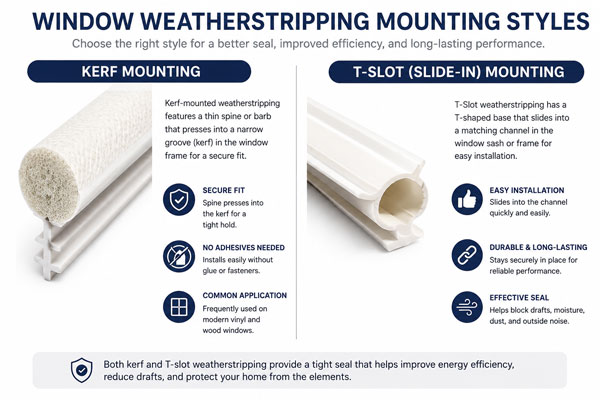
Understanding Kerf and T-Slot Weatherstripping Mounting Styles
When replacing window weatherstripping, it's important to identify the mounting style to ensure a proper fit and seal. Kerf-mounted weatherstripping features a thin spine or barb that presses into a narrow groove (kerf) in the window frame. This design creates a secure hold without the need for adhesives or fasteners and is commonly found on modern vinyl and wood windows.
T-Slot weatherstripping, sometimes called slide-in weatherstripping, uses a T-shaped base that slides into a matching channel in the window sash or frame. This mounting style allows for easy installation and replacement while providing a durable, long-lasting weather seal. Both kerf and T-slot weatherstripping help reduce drafts, improve energy efficiency, and keep out dust, moisture, and outside noise when properly installed.
Explore Door and Window Weather Stripping Here
Have questions about the different types of door and window weather stripping before you install it? We are here to help. Get in touch with us directly at 727-386-4629 and talk to a real representative that can help you find what you need.
- 0 items